


Siena is once again a leader in scientific research and biomedical innovation.
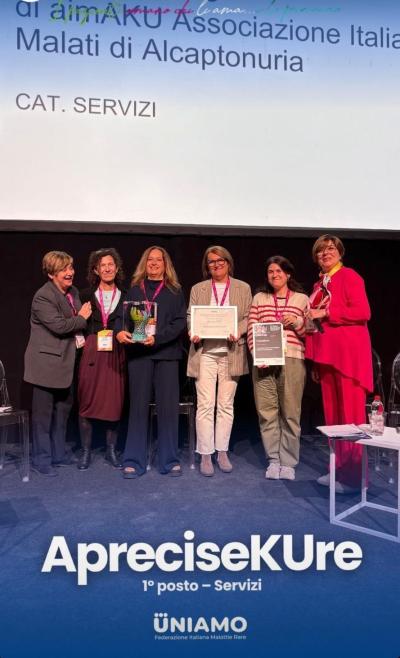
The ApreciseKUre project, developed at the University of Siena by the research group led by Professor Annalisa Santucci, won the 5th Uniamo Rare Disease Award, a prestigious honor presented on October 22 at the Leopolda Health Forum in Florence.
The award recognizes an initiative conceived entirely in Tuscany that combines scientific excellence, digital innovation, and social commitment. ApreciseKUre is a digital ecosystem for precision medicine dedicated to alkaptonuria (AKU), an ultra-rare genetic disease affecting approximately 1,300 people worldwide. The platform, designed and coordinated by the Siena-based group, integrates genetic, biochemical, and clinical data from researchers, physicians, and patients, and uses advanced artificial intelligence (AI) techniques to analyze complex patterns, identify subgroups, and personalize treatments.
The database currently contains data from over 210 AKU patients from various countries and is continually enriched with new information, including medical images and case reports published in the literature. This multidimensional approach enables a more comprehensive understanding of the disease and paves the way for increasingly targeted therapeutic strategies.
A distinctive feature of the project is its close collaboration with the patient community, through the aimAKU – Italian AKU Patients Association, of which Professor Annalisa Santucci is also vice president. Together, researchers and patients co-design tools, research priorities, and data collection methods, building a participatory research model that centers on the individual and knowledge sharing.
Thanks to its modular and scalable structure, the ApreciseKUre platform is designed to be replicated for other rare diseases, overcoming the limitations imposed by data scarcity and information fragmentation.
“This recognition,” said Professor Annalisa Santucci, “is a recognition of collaboration. It demonstrates that when science, institutions, and patients work together, we can truly build a more equitable, inclusive, and personalized medicine for each individual.”
The Uniamo Award thus confirms the University of Siena’s role as an international center of excellence in rare disease research and reaffirms the importance of the link between scientific innovation and civic engagement.
The Department of Biotechnology, Chemistry and Pharmacy (DBCF) is partner of the European Training Network EuroNeurotrophin (http://www.euroneurotrophin.eu/) dedicated to the discovery of small molecule neurotrophin mimetics as potential therapeutic agents for neurodegeneration and neuroinflammation. The project has been financed in the frame of the Marie Sklodowska-Curie Innovative Training Networks 2017. The University of Siena BCF Department participates to the project with the laboratory of Protein Crystallography headed by Prof. Stefano Mangani.
More details are provided in the press release announcement and in the project web-page.
UNISI leader:
Funding: EMFF – Blue Economy-2018
Partners:
NTT Italia, CSIC Spagna, Tecnopackaging Spagna, Università della Tuscia,ANFACO-CEC Spagna,
Project coordinator:
Funding: HORIZON2020-MSCA-ITN-2016
Marie Sklodowska-Curie Actions (ITN)
Partners: Oroboros Instruments GmbH, Universitat de Valencia, The Queen's University of Belfast, Sehorse Bioscience, National Institute for bioprocessing training research, Exosomics Siena SpA, Fraunhofer Society, Andor Technology, Almac Diagnostics, Opsona Therapeutics
UNISI Leader:
Funding: H2020 SC1-2016-2017
Partners: INSERM (Francia), Università di Heidelberg (Germania), Fundacao Oswaldo Cruz (Brasile), Erasmus Univeritair Medisch Centrum Rotterdam (Olanda), Università di Leiden (Olanda), Università Cattolica di Lovanio (Belgio), Università di Bonn (Germania), Instituto Pasteur (Francia), the Chancellor masters and scholars of the University of Oxford (UK), Inserm - Trasnfert SA (Francia), Institut de recherche pour le development (Francia), Fundacao Bahiana de Infectologia (Brasile), Commissaria a l'energie atomique e aux energies alternatives (Francia), Centre National de la recherche scientifique (Francia), London School of Hygiene and Tropical Medicine (UK), Insituto de Higiene e Medicina tropical (Portogallo), Università d'Aix Marsiglia (Francia), Nasjonalt folkehelseinstitutt (Norvegia), Insituto Nacional de Salud publica (Mexico), Instituto mexicano del seguro social (Mexico)
UNISI leader: